
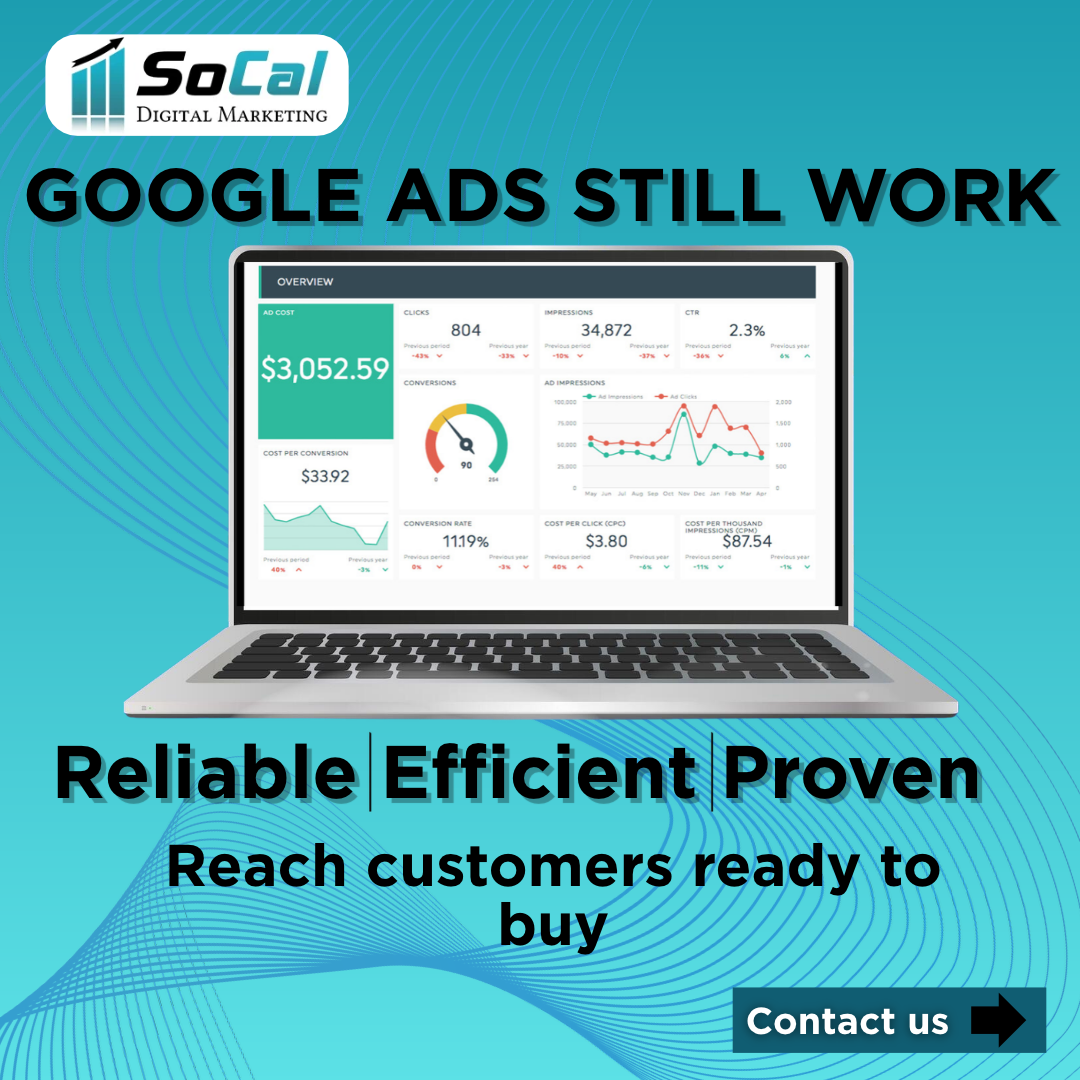
Do Google Ads Still Work? How Strategic PPC Campaigns Generate Leads
Digital marketing continues to evolve. Artificial intelligence, social media platforms, SEO, AEO and new advertising channels are changing how businesses reach potential customers.
But one question businesses continue to ask is:
Do Google Ads still work?
The short answer is yes, when campaigns are built and managed correctly.
Google Ads continues to give businesses the ability to reach potential customers at the exact moment they are actively searching for a product, service or solution.
Unlike advertising that attempts to create demand from a passive audience, search advertising can reach people who have already demonstrated intent through what they are searching for.
At SoCal Digital Marketing, we have more than 15 years of experience setting up, managing, analyzing and optimizing digital advertising campaigns.
That experience has shown us that Google Ads performance depends on much more than increasing a budget.
Successful campaigns require the right keywords, compelling ad copy, geographic targeting, effective landing pages, accurate conversion tracking and continuous analysis.
Google Ads Still Produce Measurable Results
Google Ads remains an important lead generation channel because campaign performance can be measured from the initial click through the conversion.
Current industry data also shows that businesses continue to generate measurable leads through paid search.
WordStream analyzed more than 13,000 search advertising campaigns for its 2026 benchmark report and found an average conversion rate of 8.18 percent, an average cost per click of $5.42, and an average cost per lead of $66.69 across its dataset. Results vary considerably between industries, but the data demonstrates that businesses continue to generate conversions through search advertising.
For a lead generation business, a conversion might be a phone call, contact form submission, appointment request, consultation request, quote request, online purchase or another valuable customer action.
This makes Google Ads particularly useful for businesses that want to understand where their marketing dollars are going.
SoCal Digital Marketing Has More Than 15 Years of Digital Marketing Experience
Platforms and advertising technology have changed, but experience still matters.
SoCal Digital Marketing owner Andrew Guida has worked in internet marketing since 2011, giving the agency more than 15 years of digital marketing experience as of 2026.
SoCal Digital Marketing has worked with businesses throughout the United States and across a wide variety of industries, including legal services, cybersecurity, real estate, manufacturing, professional services, local businesses and business services.
Working across multiple industries is valuable because there is no universal Google Ads strategy.
A search campaign for a law firm should not be managed the same way as a manufacturing campaign.
Customer intent, keyword costs, sales cycles, geographic targeting, landing pages and the value of each lead can all be different.
Our job is to understand those differences and build the campaign around the economics and goals of the individual business.
Experience Managing a $440,000 Annual Google Ads Budget for One Client
Experience becomes especially important as advertising budgets increase.
SoCal Digital Marketing has managed a single client whose Google Ads budget reached approximately $440,000 per year.
This was not the combined advertising spend of multiple clients.
It was the annual Google Ads budget of one high budget client, giving our team firsthand experience managing and optimizing a substantial paid search investment.
Managing a large budget is not simply about spending more money.
The objective is to make that budget work more efficiently.
For this campaign, the cost per conversion was previously approximately $4,000.
Through campaign optimization, including better keyword targeting, landing page improvements and stronger advertising copy, SoCal Digital Marketing helped reduce the cost per conversion to approximately $600.
That represents a significant improvement in campaign efficiency.
It is also an example of why simply launching a Google Ads campaign is not enough.
A campaign must be continually analyzed, tested and improved.
What Makes a Google Ads Campaign Effective?
A successful Google Ads campaign depends on several elements working together.
Targeting the Right Keywords
Keywords connect customer searches with advertisements.
However, generating more clicks is not necessarily the goal.
The goal is to attract the right clicks.
A keyword may generate significant search volume but still be a poor investment if the people searching for it rarely become customers.
Keyword research should consider search intent, competition, cost per click, conversion potential, geographic relevance, customer value and negative keywords.
Removing irrelevant traffic can sometimes be just as valuable as finding additional keywords.
Writing Better Ad Copy
An advertisement has a limited amount of space to convince someone to click.
Strong headlines and descriptions should clearly communicate what the business offers, why someone should choose the business, what makes the offer different and what action the potential customer should take next.
Good advertising copy should also align closely with what the customer is searching for.
The more closely the advertisement matches the customer’s intent, the more likely the visitor may be to become a qualified lead.
Improving the Landing Page
Getting someone to click an advertisement is only the first step.
The page someone reaches afterward can determine whether the advertising budget generates a lead or goes to waste.
A strong landing page should quickly help visitors answer four important questions.
Am I in the right place?
Does this company provide what I need?
Why should I trust them?
What should I do next?
Landing page optimization may include improving messaging, simplifying contact forms, strengthening calls to action, improving page speed and making the page easier to use on mobile devices.
Landing page improvements were one of the areas SoCal Digital Marketing focused on when helping reduce the cost per conversion for the high budget campaign discussed above.
Is Google Ads an Affordable Way to Generate Leads?
Google Ads can be cost effective, but affordability depends heavily on the business and industry.
Some industries have considerably higher advertising costs than others.
WordStream’s 2026 benchmark data reported an overall average Google Ads cost per click of $5.42. However, average costs ranged from approximately $1.63 for Arts and Entertainment to $9.87 for Attorneys and Legal Services.
That means it would be misleading to claim that Google Ads is always inexpensive.
Its major advantages are control and measurability.
Businesses can establish campaign budgets, target specific geographic areas, measure conversions, analyze cost per lead and make adjustments based on performance.
Google also provides bidding strategies designed to maximize conversions within the campaign budget.
This gives businesses considerably more information about marketing performance than many traditional forms of advertising.
What Does Google Say About Google Ads ROI?
Google’s own economic impact methodology estimates that businesses generate an average of approximately $2 in profit for every $1 spent on Google Ads.
That figure comes from Google’s own economic methodology and should not be treated as a guarantee for an individual advertiser. Actual results depend on the industry, campaign quality, competition, targeting, advertising budget, customer value and many other factors.
For an individual business, a more useful question is:
What does one qualified lead cost, and what is that lead worth to the company?
A $100 lead might be highly profitable for a business where one new customer is worth $10,000.
That same $100 lead could be unsustainable for a company earning only $50 from each customer.
That is why SoCal Digital Marketing focuses on cost per conversion and return on investment rather than simply trying to generate inexpensive clicks.
Google Ads Lets Businesses Reach Customers With High Intent
Another major advantage of Google Ads is timing.
Someone scrolling through social media may or may not currently need your service.
Someone searching for “personal injury attorney near me,” “cybersecurity company for small business,” or “industrial equipment manufacturer” is communicating a much clearer need.
Search advertising gives businesses an opportunity to appear during that research and purchasing process.
That does not mean every search becomes a customer.
However, targeting searches with strong customer intent can help businesses focus advertising spend on people who are already researching the products or services they provide.
Google Ads Requires Ongoing Optimization
One of the most common Google Ads mistakes is creating a campaign and then leaving it alone.
Search behavior changes. Competitors change. Keyword costs change. Landing page performance changes. New search terms appear.
Successful PPC management requires ongoing analysis.
At SoCal Digital Marketing, campaign optimization can include:
- Reviewing search terms
• Adding negative keywords
• Adjusting keyword targeting
• Testing headlines and descriptions
• Improving landing pages
• Monitoring cost per conversion
• Reviewing geographic performance
• Analyzing conversion rates
• Adjusting budgets
• Tracking lead quality
The objective is not simply to increase traffic.
It is to continually improve the relationship between advertising spend and business results.
SEO and Google Ads Can Work Together
Google Ads does not need to replace SEO.
In many cases, the two channels can strengthen one another.
SEO is designed to build organic visibility over time, while Google Ads allows businesses to compete for relevant searches through paid placements.
Paid advertising can also provide useful information for an SEO strategy.
If certain keywords repeatedly produce qualified Google Ads leads, those same topics may deserve additional attention within website content and SEO campaigns.
Likewise, strong organic website content can provide better landing page experiences for advertising campaigns.
SoCal Digital Marketing provides both SEO and Google Ads services, allowing information from each marketing channel to contribute to a broader search marketing strategy.
Google Ads Still Work, But Strategy Matters
Google Ads is not a button that automatically produces leads.
The platform gives businesses access to potential customers, but campaign strategy determines how effectively advertising dollars are used.
Our experience managing campaigns has repeatedly shown the importance of better keywords, better advertisements, better landing pages, better tracking and better analysis.
When those pieces work together, Google Ads can remain a highly measurable and effective source of new business.
The improvement from approximately $4,000 per conversion to approximately $600 per conversion for one high budget client demonstrates why ongoing campaign management can make such a significant difference.
Work With an Experienced Google Ads Management Company
SoCal Digital Marketing brings more than 15 years of digital marketing experience to Google Ads campaign management.
Our experience includes managing a single client with an annual Google Ads budget of approximately $440,000, along with campaigns across industries including legal services, real estate, cybersecurity and manufacturing.
We focus on understanding what produces leads, not simply what produces clicks.
If your existing Google Ads campaign is generating expensive or poor quality leads, or you are considering launching paid search for the first time, SoCal Digital Marketing can evaluate your campaign goals and identify opportunities for improvement.
Contact SoCal Digital Marketing to discuss your Google Ads and PPC strategy.
Frequently Asked Questions About Google Ads
- Do Google Ads still work in 2026?
Yes. Google Ads can still generate qualified leads when campaigns are properly targeted and optimized.
WordStream’s 2026 benchmark data reported an average conversion rate of 8.18 percent across more than 13,000 search advertising campaigns in its dataset. Performance varies considerably depending on industry, location, offer, landing page and campaign strategy.
- Is Google Ads an affordable way to generate leads?
Google Ads can be cost effective because businesses control their budgets and can measure the cost of individual conversions.
However, it is not automatically the cheapest marketing channel.
Competitive industries may have considerably higher costs per click and costs per lead than other industries. The more important measurement is whether the value generated by the leads exceeds the cost required to acquire them.
- How much should a business spend on Google Ads?
There is no universal Google Ads budget.
The appropriate amount depends on keyword costs, geographic location, competition, conversion rates, customer value and campaign goals.
A smaller local business may require a very different budget from a national company operating within a highly competitive industry.
- How can you lower the cost per lead in Google Ads?
Businesses may improve cost per lead through better keyword targeting, negative keywords, stronger advertising copy, improved landing pages, geographic targeting, accurate conversion tracking and ongoing campaign analysis.
SoCal Digital Marketing has used these strategies to help one high budget client reduce cost per conversion from approximately $4,000 to approximately $600.
- Is Google Ads better than SEO for lead generation?
Neither channel is universally better.
Google Ads can provide visibility quickly for targeted searches, while SEO is designed to develop organic visibility over a longer period.
Many businesses benefit from using both because Google Ads provides immediate campaign data while SEO builds a longer term source of search visibility.
Leave A Comment